
Understanding the Essential Role of the Bone Skid in Modern Orthopedic Surgery
Welcome to Grey Medical, your trusted partner in premium-quality surgical instruments. With decades of experience in the medical industry, we pride ourselves on delivering precision-crafted tools designed to meet the rigorous demands of surgeons, doctors, and medical professionals worldwide. In the complex world of orthopedic procedures, having reliable and ergonomic instruments is critical for achieving successful patient outcomes. Among the many specialized tools found in an orthopedic surgical tray, the bone skid stands out as an indispensable levering instrument. Designed specifically to assist surgeons in manipulating, elevating, and aligning displaced bone fragments or joint components, this tool bridges the gap between brute force and delicate surgical finesse, ensuring procedures are carried out with maximum efficiency and minimal trauma to surrounding tissues.
The Structural Anatomy and Ergonomic Design of the Instrument
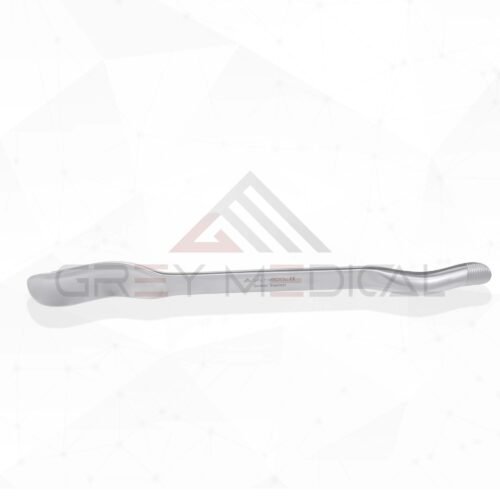
The physical construction of a bone skid is a testament to thoughtful surgical engineering, combining strength with smoothness to protect delicate anatomical structures. Typically forged from high-grade German stainless steel, the instrument features a long, sturdy shaft that provides the surgeon with optimal mechanical advantage and reach within deep surgical sites. At the working end, the shaft transitions into a slightly curved, spoon-like or spatula-shaped blade with smooth, rounded edges. This specific curvature is intentionally crafted to cradle the natural contours of human bones, such as the femoral head or the humeral condyles, preventing accidental gouging, slipping, or soft tissue laceration during high-tension maneuvers. Additionally, the handle is often ergonomically contoured or knurled to guarantee a secure, non-slip grip even when gloved hands encounter fluids in the operating theater.
Primary Clinical Applications in Joint Reduction and Trauma
In daily surgical practice, the bone skid plays a pivotal role during open reduction procedures, particularly in hip and shoulder arthroplasties as well as complex fracture repairs. When a joint is dislocated or a bone fragment is stubbornly wedged out of alignment, manual traction alone is frequently insufficient to guide the anatomy back into its proper socket. Surgeons insert the curved tip of the instrument beneath the displaced bone or prosthetic component, using the adjacent bone structure or acetabular rim as a natural fulcrum. By applying controlled, steady leverage, the surgeons bone saw can smoothly glide the bone into its correct anatomical position. This controlled gliding action is precisely where the instrument derives its name, allowing for seamless reduction without the need for excessive pulling that could strain nerves or blood vessels.
Minimizing Soft Tissue Trauma Through Controlled Leverage
One of the most significant advantages of utilizing a bone skid over improvised levering tools is the dramatic reduction in iatrogenic soft tissue damage. Orthopedic surgeries often take place in confined anatomical spaces surrounded by vital neurovascular bundles, tendons, ligaments, and articular cartilage. Sharp or poorly angled instruments can easily crush cartilage surfaces or tear muscle fibers when force is applied. Because this specialized lever features polished, atraumatic surfaces and a broad contact area, it distributes mechanical pressure evenly across the bone cortex. Consequently, surgeons can exert the necessary force to overcome strong muscular contractions while safeguarding the integrity of the joint capsule and adjacent cartilage, which directly translates to faster post-operative recovery and reduced pain for the patient.
Selecting the Right Size and Variant for Specific Procedures
Because human anatomy varies significantly across patient demographics and surgical sites, choosing the appropriate dimensions of a bone skid is vital for procedural success. Manufacturers produce these instruments in a wide array of lengths, blade widths, and degrees of curvature to accommodate everything from small pediatric bones to robust adult femurs. For instance, a Murphy-style variant typically offers a wider, more pronounced scoop ideal for hip joint manipulation, whereas narrower profiles are favored for smaller joints like the elbow, ankle, or wrist. Surgeons and operating room nurses carefully evaluate pre-operative imaging to ensure the surgical tray is stocked with the exact size needed, ensuring the blade fits snugly against the target bone without overcrowding the incision site.
Material Durability and Sterilization Standards in Healthcare
Surgical instruments subjected to heavy levering forces must exhibit exceptional tensile strength and resistance to bending or fracturing under stress. High-quality orthopedic levers undergo rigorous heat-treatment and passivation processes during manufacturing to achieve the ideal balance of hardness and flexibility. Furthermore, because these instruments are reusable, they must withstand repeated cycles of aggressive decontamination and high-temperature autoclave sterilization without corroding, pitting, or losing their mirror-smooth finish. Any microscopic roughness on the blade surface could compromise its smooth gliding capability or harbor bioburden, making strict adherence to international quality standards and routine maintenance essential for every healthcare facility.
Elevating Surgical Precision with Reliable Instrumentation
Ultimately, the success of intricate orthopedic interventions relies heavily on the synergy between a surgeon’s skill and the dependability of their instruments. Investing in superior-grade orthopedic levers ensures consistent performance, tactile feedback, and long-term durability in demanding clinical environments. Grey Medical remains committed to supporting surgical teams globally by providing meticulously crafted instruments that uphold the highest benchmarks of safety and precision. By equipping operating rooms with ergonomically refined and structurally sound tools, medical professionals can perform challenging bone reductions and joint reconstructions with confidence, paving the way for optimal patient mobility and long-term healing.