
8 Overlooked Factors That Can Make a Difference in RO System Reliability
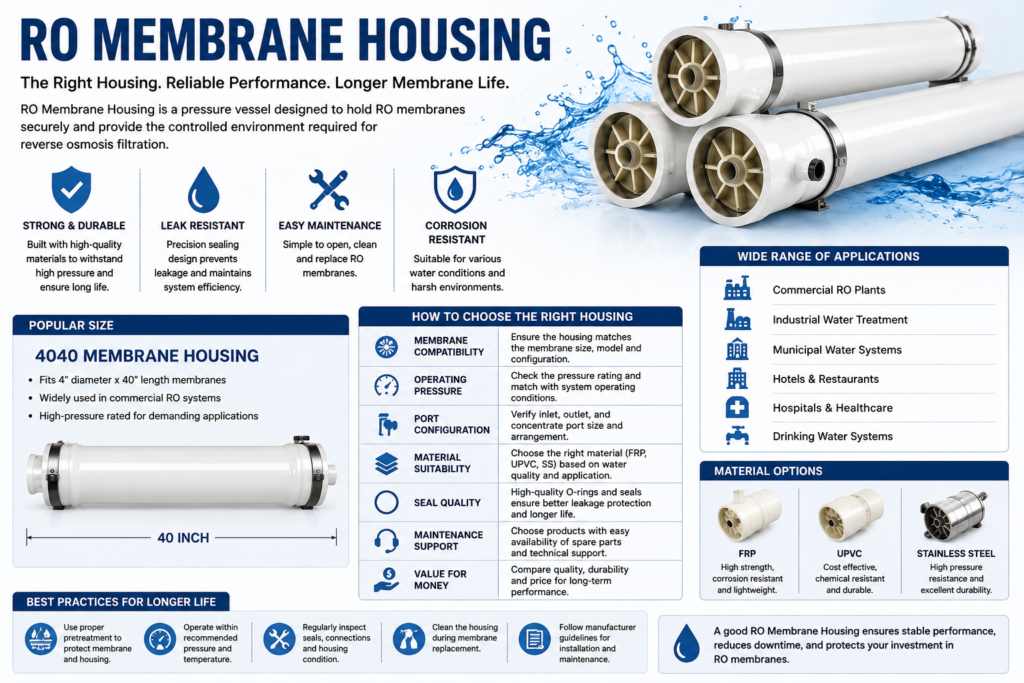
When people discuss reverse osmosis systems, the conversation usually revolves around membranes, pumps, filters, and water quality. The RO Membrane Housing often receives far less attention.
Yet this component sits directly around the membrane and has an important job: it keeps the membrane securely enclosed while allowing the RO process to take place under controlled pressure and flow conditions.
A housing that matches the membrane and system correctly can make installation and maintenance much easier. On the other hand, an unsuitable housing can introduce problems that may initially appear to be related to the membrane or plumbing.
This article explores eight practical factors that are often overlooked when selecting, installing, or maintaining RO membrane housing.
1. The Housing Should Be Selected Around the Actual Membrane
One of the easiest mistakes is to purchase a housing first and assume that the membrane will fit.
The more reliable approach is to start with the membrane specification.
An RO membrane has defined dimensions and configuration. The housing needs to accommodate those dimensions while providing the correct internal arrangement and sealing.
Before purchasing, verify:
- Membrane diameter
- Membrane length
- Membrane model
- Membrane configuration
- End arrangement
- Housing compatibility
This becomes particularly important when replacing an existing housing.
A product can look almost identical to the old housing while having small dimensional differences that make installation difficult.
2. 4040 Does Not Tell You Everything
The term RO Membrane Housing 4040 is commonly associated with commercial RO membrane systems.
The 4040 format generally refers to a membrane approximately 4 inches in diameter and 40 inches long.
However, “4040” should be treated as an identification point rather than a complete technical specification.
Two 4040 housings may differ in:
- Material
- Pressure capability
- Port configuration
- End-cap design
- Installation arrangement
- Membrane compatibility
Therefore, purchasing should not stop after confirming that a product is labeled 4040.
The complete specification should be compared with the existing RO system.
3. Pressure Rating Is a System Requirement, Not Just a Product Feature
Reverse osmosis depends on pressure to drive water through the membrane.
This means the housing is exposed to the operating pressure of the system.
The housing should therefore be appropriate for the pressure conditions under which the RO plant is designed to operate.
This is particularly important for commercial and industrial systems.
A housing that physically fits the membrane may still be unsuitable if its specifications do not match the system’s operating requirements.
Before installation, buyers and technicians should verify the applicable pressure specifications provided for both the housing and the RO system.
The objective is not simply to find a housing that fits.
The objective is to find a housing that fits and is appropriate for the intended operating conditions.
4. Port Configuration Can Turn a Simple Replacement Into a Difficult Job
A replacement housing may have the correct membrane dimensions but still fail to integrate easily with the existing RO system.
The reason can be the connection arrangement.
Depending on the housing design, the position and size of ports can vary.
This matters because existing RO plumbing is already configured around particular connections.
If the replacement housing has a different arrangement, additional fittings, adapters, or plumbing modifications may be required.
For commercial service work, this can increase installation time.
Therefore, before ordering, technicians should record the existing connection configuration and compare it with the replacement housing.
A few minutes of specification checking can prevent an unnecessary return or modification job.
5. Housing Material Should Match the Application
The material of the membrane housing is another factor that should not be overlooked.
Different applications can require different material characteristics.
Plastic-based housings may be appropriate for certain compact RO systems.
FRP constructions are widely used in water-treatment applications where strength and corrosion resistance are useful.
Stainless steel constructions may be selected in applications where robust construction and particular environmental requirements are important.
The correct choice depends on the actual system.
Factors such as water chemistry, operating conditions, pressure, installation environment, and expected service requirements should be considered.
A housing should not be selected simply because a particular material appears stronger or more premium.
6. Seals Can Become the Weakest Point
A housing body can remain in good condition while its sealing components deteriorate.
O-rings and other seals are responsible for maintaining a secure connection between housing components.
Over time, seals may be affected by repeated installation, pressure cycles, cleaning procedures, or general wear.
Possible signs of sealing problems include:
- Water around the housing
- Repeated dripping
- Leakage after membrane replacement
- Difficulty maintaining a seal
- Frequent tightening of connections
When replacing a membrane, technicians should inspect the seals instead of automatically reusing old components.
The sealing surfaces should also be clean and free from damage.
If leakage continues after replacing the seal, the housing itself should be examined.
7. The Cheapest RO Membrane Housing May Create Higher Operating Costs
When searching for RO Membrane Housing Price, buyers naturally want competitive pricing.
However, the purchase price is only one part of the overall cost.
A housing that is inexpensive but poorly matched to the system can lead to additional expenses.
These may include:
- Installation delays
- Repeated leakage
- Replacement costs
- Additional technician visits
- Plumbing modifications
- Customer complaints
- System downtime
For commercial RO operators, downtime can be particularly costly.
This is why purchasing decisions should consider total value rather than only the initial price.
A practical comparison should include:
| Factor | Purchasing Question |
|---|---|
| Compatibility | Does it fit the intended membrane? |
| Pressure | Is it suitable for system operation? |
| Material | Is it appropriate for the environment? |
| Connections | Will existing plumbing fit? |
| Seals | Are suitable replacement seals available? |
| Construction | Is it suitable for expected service? |
| Supplier | Can replacement support be obtained? |
| Price | Is the total value competitive? |
The lowest price is useful only when the product also meets the required specifications.
8. Commercial RO Housing Should Be Viewed as Part of Plant Reliability
For a domestic purifier, a membrane housing problem may affect a household.
For a commercial RO plant, the consequences can be broader.
Restaurants, hotels, hospitals, factories, offices, educational facilities, and water-treatment businesses may depend on treated water as part of their daily operations.
This makes RO Membrane Housing for Commercial RO applications a more important purchasing consideration.
The housing needs to match the membrane, pressure, connections, material requirements, and installation environment.
It should also be supported by a reliable maintenance and replacement process.
For commercial operators, component availability can be almost as important as component specifications.
Why Housing Problems Are Sometimes Misdiagnosed
RO troubleshooting often begins with the membrane.
If water production falls, the membrane may be inspected.
If leakage occurs, a fitting may be tightened.
But membrane housing problems can sometimes produce symptoms that overlap with other RO issues.
For example, leakage may originate from:
- An O-ring
- Housing threads
- End connections
- A damaged sealing surface
- A fitting
- The housing body itself
Similarly, membrane installation difficulties may result from a compatibility issue rather than a defective membrane.
This is why technicians should inspect the complete membrane assembly before replacing components unnecessarily.
A Housing Inspection Should Be Part of Membrane Replacement
Whenever a membrane is removed, the housing is already accessible.
This creates a convenient opportunity for inspection.
Technicians can check:
Housing body: Look for cracks, deformation, or physical damage.
Threads: Check for wear or damage.
Ports: Inspect connection areas.
Sealing surfaces: Look for scratches, damage, or contamination.
O-rings: Check for deterioration.
Internal condition: Confirm that the membrane can be positioned correctly.
This does not mean every housing needs to be replaced during every membrane change.
The objective is simply to identify potential problems before the system returns to operation.
The Importance of Correct Membrane Positioning
Inside the housing, the membrane needs to be positioned according to the manufacturer’s design.
Incorrect orientation or positioning can create installation problems and may prevent the assembly from functioning correctly.
This is one reason technicians should avoid relying entirely on memory when servicing different membrane housing designs.
Different products can have different configurations.
Following the applicable product instructions is preferable to assuming that every housing works exactly the same way.
Why Commercial Buyers Should Keep Specification Records
For businesses servicing multiple RO plants, maintaining basic equipment records can simplify future purchasing.
A useful record can include:
- Membrane size
- Housing model
- Housing material
- Connection configuration
- Operating pressure
- Number of membrane elements
- Installation location
- Replacement history
When a replacement is needed, the purchasing team does not have to start from zero.
This can make procurement faster and reduce the risk of ordering an incompatible product.
The Role of Housing in Preventive Maintenance
Preventive maintenance is not only about changing components at fixed intervals.
It is also about identifying conditions that may lead to failure.
Housing inspection can be included in routine maintenance activities.
Technicians can monitor whether leakage is becoming more frequent, whether seals are deteriorating, whether connections are becoming difficult to maintain, and whether the housing shows signs of physical damage.
This condition-based approach can be more useful than replacing components simply because they have reached a certain age.
How Dealers Can Improve Product Selection
RO dealers often handle inquiries that are too general.
A customer may simply ask for:
“RO membrane housing.”
Instead of immediately quoting a price, the dealer can ask for a few technical details.
For example:
Which membrane size?
Domestic or commercial system?
What connection configuration?
What material is required?
What pressure does the system operate at?
How many housings are required?
These questions turn a vague product request into a clear specification.
That can reduce incorrect quotations and unnecessary returns.
Why Availability Matters Alongside Quality
A technically suitable product is useful only if it can be sourced when required.
For RO service companies, unexpected equipment failures can happen at inconvenient times.
Having access to commonly used membrane housings can help reduce repair delays.
This is especially relevant for businesses servicing commercial systems that use common membrane formats such as 4040.
Maintaining appropriate supplier relationships and spare-part inventory can therefore support faster customer service.
The Connection Between Housing and Overall RO Performance
It is important not to overstate the role of the housing.
Water quality and production depend on many factors, including membrane condition, feed-water quality, temperature, pressure, pre-treatment, fouling, scaling, recovery, and pump performance.
The housing does not independently determine these factors.
Its role is to provide a suitable environment in which the membrane can operate.
If the housing is compatible, properly sealed, structurally suitable, and correctly installed, it supports the larger RO system.
If it is damaged or unsuitable, it can become a weak point in that system.
A Better Way to Evaluate RO Membrane Housing
Instead of asking whether a housing is “good” or “bad,” ask whether it is appropriate for the application.
For example:
A housing can be perfectly suitable for one pressure range but unsuitable for another.
A material can be ideal for one environment but unnecessary for another.
A connection configuration can work perfectly in a new RO plant but create problems when used as a replacement for an existing system.
Suitability is therefore more important than generic quality claims.
Final Thoughts
The RO Membrane Housing is one of the quieter components in a reverse osmosis system, but its role becomes obvious when something goes wrong.
A suitable housing supports membrane installation, contains pressurized water, maintains the intended flow path, provides sealing, and makes membrane servicing possible.
When selecting RO Membrane Housing 4040, buyers should verify the complete specifications rather than relying only on the 4040 designation.
When comparing RO Membrane Housing Price, the decision should consider compatibility, construction, maintenance, supplier reliability, and potential downtime—not simply the lowest purchase cost.
For RO Membrane Housing for Commercial RO applications, the selection process should be even more specification-focused because commercial systems often operate for longer periods and have greater operational requirements.
Ultimately, a membrane housing should be treated as a working part of the RO system rather than an ordinary container.
The right housing does not replace good membrane quality, proper pre-treatment, or correct operating conditions. Instead, it brings these components together in a secure and controlled assembly.
That is what makes membrane housing an important part of dependable RO system management.
