
BPC-157 and TB-500: Recovery Peptides in a Professional Formulary
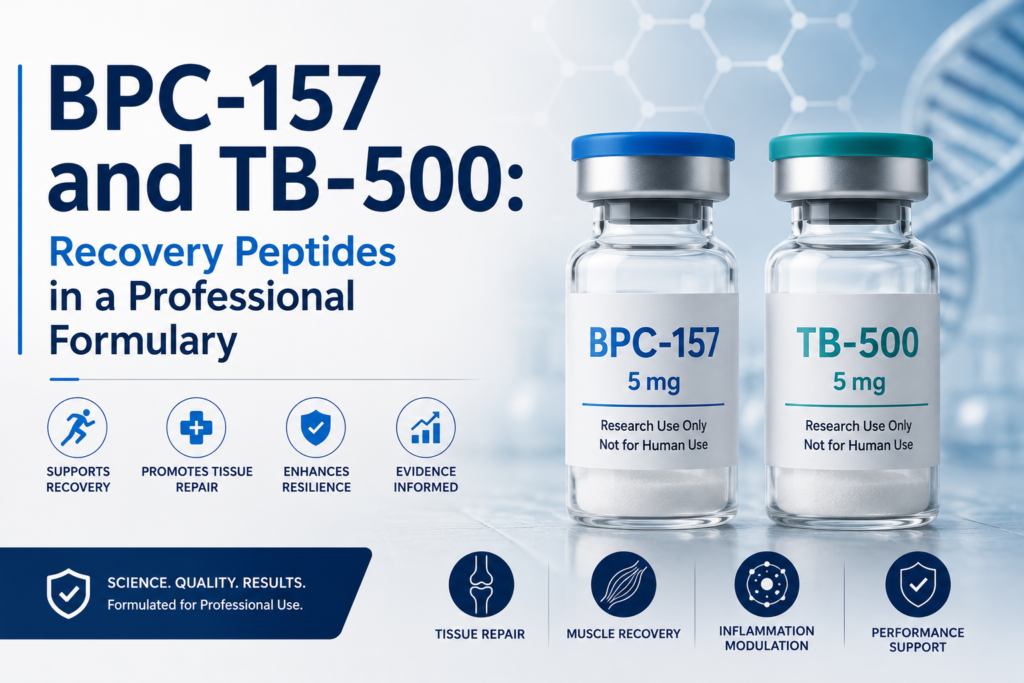
Peptide therapeutics have moved from a niche corner of sports medicine into mainstream conversation among clinicians, researchers, and wellness practitioners. Among the most discussed compounds are BPC-157 and TB-500, two peptides frequently referenced in connection with tissue repair, injury recovery, and musculoskeletal support. For any professional formulary — whether serving a compounding pharmacy, a research supplier, or a clinical wellness practice — understanding what these peptides are, how they are studied, and where the regulatory line sits is essential to responsible inclusion and marketing.
This article provides an overview of BPC-157 and TB-500: their origins, proposed mechanisms, the current state of research, and the practical considerations that any formulary manager should weigh before listing them.
What Is BPC-157?
BPC-157 (Body Protection Compound-157) is a synthetic peptide fragment derived from a protein naturally found in human gastric juice. It consists of a 15-amino-acid chain and was first isolated and studied for its apparent stability and biological activity in preclinical models. Unlike many peptides that require refrigeration and degrade rapidly, BPC-157 has been noted in early laboratory work for its relative resilience, which is part of why it has attracted sustained research interest.
The compound first drew scientific attention for its potential role in protecting and healing the gastrointestinal lining. Over time, animal studies expanded into other areas, including tendon, ligament, muscle, and nerve tissue, where researchers observed markers suggestive of accelerated healing processes. This broader interest is what has pushed BPC-157 into conversations about musculoskeletal recovery, well beyond its original gastrointestinal focus.
What Is TB-500?
TB-500 is a synthetic version of a fragment of Thymosin Beta-4, a naturally occurring protein present in nearly all human and animal cells. Thymosin Beta-4 plays a role in actin regulation — actin being a structural protein involved in cell movement, shape, and repair. Because of this role, researchers have examined TB-500 for its potential involvement in cell migration to injury sites, angiogenesis (the formation of new blood vessels), and general wound-healing cascades.
Like BPC-157, TB-500 has been studied primarily in preclinical and animal models. Its proposed relevance to soft tissue recovery has made it a frequent companion compound to BPC-157 in both research literature and informal use, with many formularies and suppliers listing the two together.
Proposed Mechanisms of Action
While the full mechanistic picture for both peptides is still being mapped, several themes recur across the available research:
Angiogenesis support. Both peptides have been studied for their potential to promote the growth of new blood vessels in and around damaged tissue, which is a foundational step in most repair processes. Improved blood flow to an injury site is generally associated with better nutrient and oxygen delivery, both of which support cellular repair.
Cell migration and proliferation. TB-500’s connection to actin regulation has led researchers to examine its role in helping repair-relevant cells — such as fibroblasts and endothelial cells — migrate to the site of injury more efficiently.
Collagen organization. Preclinical work on BPC-157 has explored its influence on collagen deposition and fibroblast activity, both central to tendon and ligament repair, where collagen alignment determines tissue strength during healing.
Anti-inflammatory signaling. Some studies have suggested modulation of inflammatory markers, which may help explain reported effects on pain and swelling in injured tissue, though this remains an active area of investigation rather than an established mechanism.
It is worth stressing that most of this evidence comes from in vitro (cell culture) and animal studies. Human clinical trial data remains extremely limited for both peptides, and the mechanisms described above should be understood as research hypotheses under continued investigation rather than settled pharmacology.
Current Research and Regulatory Status
This is the most important section for any formulary decision-maker.
Neither BPC-157 nor TB-500 has received approval from the U.S. Food and Drug Administration (FDA) for any human therapeutic use. Both compounds are generally categorized and sold as research chemicals — intended for laboratory and preclinical research purposes only, not for human or animal consumption, injection, or clinical application.
In recent years, the FDA has taken an increasingly active regulatory posture toward peptides of this class. Both BPC-157 and TB-500 have been named on FDA lists of bulk drug substances that present significant safety concerns and are not eligible for use in compounded preparations under Sections 503A and 503B of the Federal Food, Drug, and Cosmetic Act. This means licensed compounding pharmacies are restricted from formulating these peptides into patient-ready preparations, even off-label, in most circumstances. Regulatory positions in this space continue to evolve, so formulary teams should verify current FDA guidance and any relevant state pharmacy board rules before making sourcing or listing decisions.
For any business operating in the wholesale, research-supply, or compounding space, this regulatory reality should shape how these compounds are described, labeled, and marketed. Best practice includes:
- Clear “for research use only, not for human consumption” labeling on all product listings and packaging.
- Avoiding therapeutic claims (e.g., “heals tendons,” “treats injuries”) in marketing copy, since such claims characterize a product as a drug under FDA rules regardless of labeling disclaimers.
- Directing any customers with clinical questions to licensed healthcare providers rather than providing dosing or administration guidance.
- Keeping documentation of supplier certificates of analysis (COAs) for purity and identity verification, which supports both quality control and regulatory defensibility.
Why These Peptides Remain a Formulary Talking Point
Despite the regulatory constraints, interest in BPC-157 and TB-500 continues to grow, driven by a few converging factors:
Athletic and rehabilitation interest. Athletes, physical therapists, and sports medicine practitioners frequently discuss soft tissue recovery, and peptides positioned around collagen and vascular support naturally enter that conversation, even where formal clinical guidance is absent.
Preclinical research momentum. Ongoing animal and cell-based studies keep generating publications, which sustains scientific and commercial interest even without corresponding human trial data.
Compounding and wellness market growth. The broader peptide therapy market — spanning GLP-1 agonists, growth hormone secretagogues, and recovery-focused peptides — has expanded rapidly, and BPC-157/TB-500 are often mentioned in the same commercial and informational contexts even though their regulatory footing differs substantially from FDA-approved peptide drugs.
Considerations for Formulary Inclusion
For a business evaluating whether and how to list these compounds, a few practical questions are worth working through:
- What is the actual customer base? Research institutions and laboratories represent a fundamentally different regulatory context than direct-to-consumer wellness marketing implying personal use.
- Is documentation airtight? COAs, batch testing, and clear research-use labeling reduce both regulatory and reputational exposure.
- Does marketing language stay within research-use framing? Avoiding implied medical claims is not just a legal safeguard — it also sets accurate expectations for buyers about what is and isn’t established.
- Are internal teams trained on current regulatory status? Given how quickly FDA guidance on bulk substances can shift, formulary and compliance teams benefit from periodic review of current rules rather than relying on a one-time assessment.
Conclusion
BPC-157 and TB-500 sit at an interesting intersection of promising preclinical science and unresolved regulatory status. Their proposed roles in angiogenesis, cell migration, and tissue repair have made them recurring names in recovery-focused research and commercial peptide catalogs, but the absence of FDA approval and their explicit exclusion from compounding under current bulk substance guidance means they need to be handled carefully in any professional formulary. Businesses working in this space are best served by leading with accurate, research-use-only framing, maintaining rigorous documentation, and staying current on regulatory developments rather than getting ahead of the science with therapeutic claims the evidence doesn’t yet support.
As with any compound in this category, formulary teams should consult current FDA guidance and qualified regulatory counsel before finalizing sourcing, labeling, or marketing decisions.
