
Multiport Valve: The Hidden Backbone of Efficient Water Filtration Systems
- Blog
-
Aug 12
- Share post
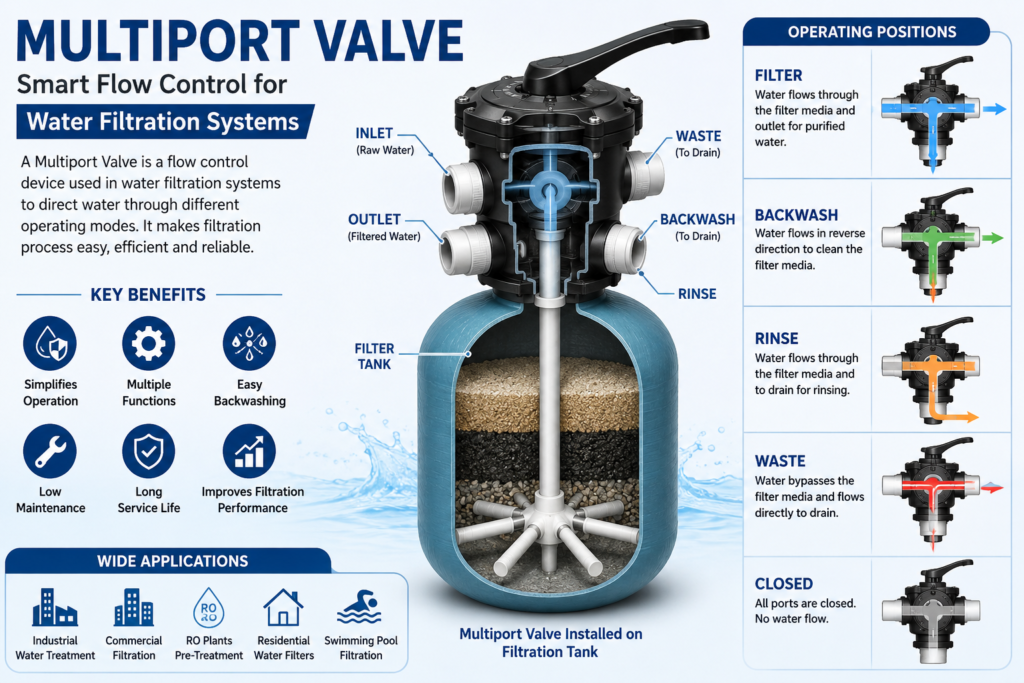
Water filtration systems are designed to perform different tasks at different stages. During normal operation, water passes through filter media to remove impurities. After a certain period of use, that same filter media needs cleaning. The cleaning process usually requires water to move in a different direction from the normal filtration flow.
This change in water direction is one of the reasons a Multiport Valve is widely used in filtration systems.
Instead of installing separate valves for filtration, backwash, rinse, and drain operations, a Multiport Valve combines these functions into a single assembly. By changing the valve position, the operator can redirect water through the required path.
This simple concept has made Multiport Valves a common component in sand filters, multimedia filters, activated carbon filters, and many commercial and industrial water treatment systems.
For RO dealers, technicians, and water treatment professionals, understanding this component is essential because it directly affects how filtration equipment operates and is maintained.
2. Why Every Filtration System Needs Flow Control
Filtration media gradually collect suspended particles as water flows through them.
A sand filter, for example, traps dirt and other suspended matter within its media bed. Over time, these impurities accumulate. If they are not removed, the filter may experience increased pressure drop and reduced performance.
To clean the media, water is directed through the filter in the opposite direction. This process is known as backwashing.
After backwashing, a rinse cycle may be performed before returning to normal service.
Without an organized flow-control arrangement, an operator might need to open and close several individual valves in the correct sequence.
A Multiport Valve simplifies this process.
The valve allows the user to select different operating modes without manually rearranging the entire piping system.
This not only makes operation easier but also helps create a cleaner and more organized filtration layout.
3. What Is a Multiport Valve?
A Multiport Valve is a mechanical valve containing multiple water connections, or ports, and several operating positions.
Each position creates a different internal water path.
The valve is usually connected to:
-
Raw water inlet
-
Filter vessel
-
Filtered water outlet
-
Drain line
-
Pump or circulation line
Depending on the selected position, these connections are linked differently inside the valve.
Common operating positions include:
-
Filter
-
Backwash
-
Rinse
-
Waste
-
Bypass
-
Recirculation
Not every Multiport Valve includes all these positions. The available functions depend on the valve model and intended application.
It is important to remember that the valve does not filter water itself. It simply directs water through the filtration equipment according to the required operating cycle.
4. How a Multiport Valve Changes Water Flow
The working principle is based on internal flow channels.
Imagine a filter vessel connected to a Multiport Valve.
During normal filtration, water enters the valve, travels into the filter vessel, passes through the media, and then returns to the valve before exiting toward the treated-water line.
When the valve is switched to the backwash position, the internal pathway changes.
Water enters the filter from a different direction, moves upward through the media, and carries accumulated particles toward the drain.
After backwashing, selecting the rinse position creates another flow arrangement that prepares the media for normal operation.
The operator does not need to disconnect any pipes. The internal valve mechanism changes the water route.
This is the main advantage of using a Multiport Valve.
5. Understanding the Main Valve Positions
Filter Position
This is the normal operating mode.
Water flows through the filtration media in the intended direction, and the filtered water moves toward the next stage.
Backwash Position
Backwashing cleans the filter media.
Water is directed through the media in reverse, helping loosen accumulated impurities and discharge them through the drain.
The correct backwash flow depends on the media type and vessel design.
Rinse Position
After backwashing, the media may need to settle.
The rinse cycle flushes remaining impurities and prepares the filter to return to service.
Waste Position
Some Multiport Valves include a waste setting.
This allows water to be discharged directly to the drain instead of passing through the normal filtered-water outlet.
Bypass or Recirculation
Certain valve models provide additional flow paths for specialized applications.
These functions vary between manufacturers, so the product specifications should always be reviewed before purchase.
6. Where Multiport Valves Are Used
Multiport Valves have applications across many water filtration systems.
Sand Filters
Sand filters are one of the most common applications.
Because the media captures suspended solids, periodic backwashing is necessary.
A Multiport Valve provides convenient control over the filter and backwash cycles.
Multimedia Filters
Multimedia filters use several layers of filtration media.
These systems are frequently installed as pre-treatment before RO plants and require regular cleaning.
A compatible Multiport Valve helps manage these cycles.
Activated Carbon Filters
Activated carbon filtration is used for applications such as chlorine reduction, taste improvement, and odor control.
Depending on the system design, the filter may require periodic backwashing.
Water Softeners
Some water softening systems use specialized valves to control service and regeneration cycles.
The exact valve configuration depends on the softener design.
Commercial Filtration Systems
Hotels, hospitals, restaurants, schools, and commercial buildings often use media filters that require routine maintenance.
Multiport Valves can simplify operation in these installations.
Industrial Water Treatment
Industrial plants use larger filtration vessels with higher flow requirements.
When appropriately sized, Multiport Valves can support service and backwash operations in these systems.
7. Multiport Valve in RO Pre-Treatment
A Multiport Valve is not part of the RO membrane itself.
Its primary role is generally within the pre-treatment section.
An industrial RO plant may include:
Raw Water Tank
↓
Multimedia Filter
↓
Activated Carbon Filter
↓
Water Softener
↓
Cartridge Filter
↓
The multimedia and activated carbon filters can accumulate impurities during operation.
When cleaning is required, the Multiport Valve allows the operator to change the water flow to perform backwashing and rinsing.
This helps maintain the pre-treatment equipment that supplies water to the RO membrane.
The correct valve must be selected according to the vessel size, operating flow, pressure, and required functions.
8. Manual vs Automatic Multiport Valve
The operating method is an important consideration.
Manual Multiport Valve
A manual valve is operated using a selector handle.
It is commonly used where:
-
The system is relatively small.
-
An operator is available.
-
Backwashing is performed manually.
-
Automation is not required.
Manual valves are straightforward and practical for many filtration systems.
Automatic Multiport Valve
An Automatic Multiport Valve changes operating modes through a control mechanism or programmed sequence.
It can be useful for:
-
Commercial treatment plants
-
Industrial filtration systems
-
Automated RO pre-treatment
-
Large water treatment installations
-
Systems requiring scheduled backwashing
Automatic valves can reduce manual intervention, but they must be compatible with the plant’s control and operating conditions.
9. Benefits of Installing a Multiport Valve
Easier Operation
Several flow-control functions are available from one valve.
Simplified Backwashing
The operator can select the appropriate backwash position without changing multiple valves.
Organized Plumbing
Combining multiple functions into one assembly can reduce the complexity of the piping arrangement.
Faster Maintenance
Routine filtration maintenance becomes more convenient.
Multiple Operating Modes
The valve supports different stages of filter operation through separate positions.
Wide Range of Applications
Multiport Valves are available in different sizes for commercial and industrial filtration systems.
Better Process Control
When correctly matched to the system, the valve helps maintain the intended flow sequence during filtration and cleaning cycles.
10. Selecting the Correct Multiport Valve
Choosing the correct valve requires careful consideration.
Valve Size
The connection size should match the filter vessel and plumbing.
Flow Capacity
The valve must handle both normal filtration flow and the required backwash flow.
Pressure Rating
The operating pressure of the system should remain within the valve’s specified limits.
Number of Functions
Select a valve that provides all the operating positions required by the filtration system.
Connection Type
Threaded or other connection arrangements should match the existing installation.
Vessel Compatibility
The valve should fit the filter vessel and internal distributor arrangement.
Material
Valve construction should be suitable for the water quality and operating environment.
Manual or Automatic
Choose the operating method based on the level of automation required.
Selecting the right valve from the beginning can help prevent installation difficulties and unnecessary replacement costs.
11. Installation Best Practices
Proper installation is essential for reliable operation.
Before installation, technicians should:
-
Review the manufacturer’s connection diagram.
-
Identify each port correctly.
-
Check seals and O-rings.
-
Ensure the piping is properly aligned.
-
Confirm vessel compatibility.
-
Verify pressure requirements.
The selector handle should always be operated carefully.
For many valve designs, changing positions while the system is pressurized can damage internal components.
After installation, the system should be tested to ensure that each valve position produces the intended water flow.
Checking for leaks during commissioning can also help identify installation issues early.
12. Maintenance and Troubleshooting
Like any mechanical component, a Multiport Valve benefits from regular inspection.
Technicians should look for:
-
Water leakage
-
Damaged seals
-
Stiff selector movement
-
Cracks
-
Loose connections
-
Incorrect flow paths
Leakage
Leaks may result from worn seals or improperly tightened connections.
Incorrect Flow
If water is not following the expected route, check the valve position and piping connections.
Difficult Operation
A selector that is difficult to move should not be forced.
The cause may be related to pressure, wear, or another mechanical issue.
Poor Backwash
Poor backwashing is not always caused by the valve.
Insufficient flow, incorrect media quantity, or unsuitable vessel sizing can also affect cleaning performance.
Regular maintenance of both the valve and the filter vessel helps support reliable operation.
13. Importance for RO Dealers and Water Treatment Businesses
RO dealers and water treatment professionals often work on systems with different capacities and configurations.
A small commercial filter may require a different valve from a large industrial treatment plant.
Before purchasing a Multiport Valve, it is useful to have the following information available:
-
Filter vessel diameter
-
Connection size
-
Required flow rate
-
Operating pressure
-
Required operating positions
-
Manual or automatic control
-
Mounting arrangement
Having these specifications ready makes it easier to identify a compatible product.
RO Mega Mart is a B2B platform focused on the RO and water treatment industry, where business buyers can explore filtration components, RO spare parts, and related water treatment products.
For dealers, distributors, and technicians, comparing specifications before ordering can reduce compatibility issues and help streamline procurement.
14. Conclusion
A Multiport Valve serves as an important control point in many water filtration systems. While it does not remove contaminants itself, it directs water through the different stages required for filtration, backwashing, rinsing, and draining.
Its practical design has made it useful in sand filters, multimedia filters, activated carbon systems, commercial water treatment units, and RO pre-treatment plants.
The key to reliable performance is selecting a valve that matches the complete filtration system. Connection size, flow capacity, pressure rating, vessel compatibility, operating positions, and the choice between manual and automatic control should all be evaluated before purchase.
For RO dealers, technicians, distributors, and water treatment businesses, understanding these factors helps ensure that the selected Multiport Valve supports efficient operation and convenient maintenance.
When the valve, filtration vessel, media, and operating conditions are properly matched, a Multiport Valve can simplify flow management and become a dependable part of a well-designed water treatment system.
