
RO Chemicals: What Your RO Plant Is Telling You Before a Major Problem
- Blog
-
Aug 17
- Share post
An RO plant usually does not become inefficient overnight. Before a membrane fails, production often starts changing quietly. Pressure may increase, permeate flow may decline, conductivity may move away from its normal range, or the plant may require cleaning more often.
These changes are easy to overlook when the system is still producing water.
But an experienced RO operator knows that these small changes can tell an important story.
One of the factors worth examining is the chemical treatment program. RO Chemicals have a specific role in managing the conditions that can affect membranes, but their effectiveness depends on proper product selection, dosage, feed-water quality, pretreatment, and monitoring.
The real question is not simply whether an RO plant is using chemicals. The better question is whether the chemicals being used actually match the plant’s requirements.
Featured Snippet: What Are RO Chemicals Used For?
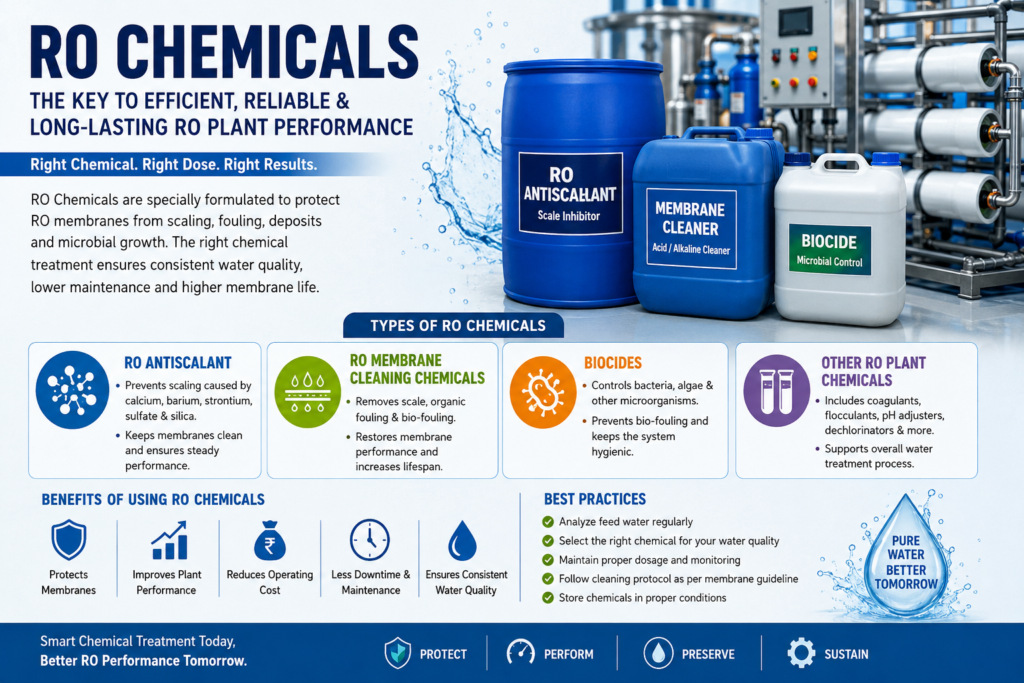
RO Chemicals are water-treatment chemicals used in reverse osmosis systems to control problems such as mineral scaling, membrane fouling, biological growth, and accumulated deposits. Common RO chemicals include antiscalants, membrane cleaning chemicals, biocides, and specialty treatment chemicals selected according to feed-water quality and RO operating conditions.
The Numbers on an RO Plant Can Reveal More Than You Think
An RO plant generates useful information every time it operates.
Feed pressure, permeate flow, conductivity, recovery, differential pressure, and salt rejection are not just numbers recorded for documentation. Together, they can help operators understand how the membrane system is behaving.
Imagine a plant that normally operates at a particular pressure and produces a consistent volume of permeate.
Over time, the pressure begins increasing.
The operator adjusts the system to maintain production.
A few weeks later, the pressure increases again.
Eventually, the membrane requires cleaning.
At this stage, the problem may look like a membrane issue. But the underlying reason could be scaling, fouling, a change in feed-water chemistry, inadequate pretreatment, or an unsuitable chemical program.
This is why trends matter.
RO Chemicals Should Match the Actual Water
One of the biggest mistakes in chemical selection is treating every RO plant as if it receives the same water.
It does not.
A borewell may have high hardness and dissolved minerals. Municipal water may have a different balance of salts and treatment residuals. Industrial water can contain organic substances or process-specific contaminants.
Even the same water source can change over time.
This means the chemical program should be connected to actual water conditions.
Water analysis can provide information about parameters such as hardness, alkalinity, silica, iron, conductivity, total dissolved solids, and other relevant characteristics.
The objective is to understand what the membrane is likely to encounter and then select treatment accordingly.
Why Scaling Can Become an Expensive Problem
Scaling occurs when dissolved substances precipitate and form deposits.
During RO operation, rejected substances become concentrated. If the concentration and operating conditions reach an unfavorable point, scale can form on the membrane.
The deposit can interfere with water transport through the membrane surface.
Initially, the change may be small.
Then the operator may notice lower permeate flow or increasing pressure.
If the condition continues, the membrane may require cleaning sooner than expected.
This is where RO Antiscalant can be useful.
An appropriate antiscalant can help control the tendency of certain scale-forming substances to precipitate and deposit under suitable operating conditions.
However, antiscalant is not a magic solution. Its selection should be based on the water chemistry and the actual scaling potential of the system.
Why Antiscalant Dosage Deserves Attention
Using the correct antiscalant is important, but dosage is equally significant.
Too little treatment may not provide the intended level of scale control.
Too much treatment can increase chemical consumption without necessarily producing better results.
Dosing accuracy can be affected by changes in feed flow, pump calibration, chemical concentration, preparation practices, and dosing equipment condition.
Therefore, operators should not assume that a dosing pump set to a particular value will always deliver exactly the intended quantity.
Regular verification can help maintain a more consistent chemical program.
Not Every Deposit Is Scale
This is an important point when diagnosing RO membrane problems.
A membrane surface can be affected by different types of deposits.
Mineral scale is one possibility.
Organic matter, colloidal particles, suspended material, and biological growth can create other types of fouling.
The symptoms can overlap.
A reduction in permeate flow, increasing pressure, and higher differential pressure can occur with more than one type of membrane problem.
That means the chemical solution should not be selected simply from the symptom.
The cause needs to be investigated.
Where RO Membrane Cleaning Chemicals Become Important
Preventive chemical treatment can help control certain risks, but membranes may still require periodic cleaning.
When deposits accumulate and membrane performance is affected, RO Membrane Cleaning Chemicals can be used as part of an appropriate cleaning procedure.
The cleaning chemical should be selected according to the nature of the deposit.
For example, a mineral deposit may require a different cleaning approach from organic or biological fouling.
Membrane compatibility is also critical.
The cleaning chemical, concentration, temperature, cleaning duration, and procedure should be suitable for the membrane manufacturer’s specifications.
A cleaning process that is not properly matched to the membrane can create additional problems instead of solving the original one.
The Most Useful Question After Cleaning
Suppose an RO membrane is cleaned and its performance improves.
The operator may consider the problem solved.
But there is another question worth asking:
Why did the deposit form in the first place?
If the membrane becomes heavily fouled again after a short period, the cleaning process has only treated the symptom.
The underlying cause could be:
- Poor pretreatment
- Feed-water changes
- Incorrect antiscalant
- Incorrect chemical dosage
- High recovery
- Biological growth
- Inadequate filtration
- Operating conditions outside the intended range
Repeated cleaning without investigating the cause can increase both maintenance requirements and chemical costs.
Pretreatment Has a Bigger Role Than Many Operators Realize
The RO membrane should not be expected to handle everything by itself.
Pretreatment reduces the load placed on the membrane.
Depending on the feed-water characteristics, an RO system may include multimedia filtration, activated carbon, softening, cartridge filtration, micron filtration, or other processes.
Each stage has its own purpose.
If pretreatment performance deteriorates, the RO membrane can suddenly receive a higher contaminant load.
In that situation, increasing RO Plant Chemicals may not be the best answer.
The pretreatment system should also be inspected.
This is why RO maintenance works best when the entire treatment chain is considered rather than looking at the membrane alone.
When the Water Source Changes, the Chemical Program May Need to Change
Water chemistry is not always fixed.
Seasonal conditions can influence groundwater. Industrial processes can change the composition of wastewater. A change in the water source can also introduce a different chemical profile.
When the feed water changes significantly, the previous chemical program may no longer provide the same performance.
This does not necessarily mean the existing product is bad.
It may simply mean that the operating conditions have changed.
Regular water testing can help operators identify these changes before they become major membrane problems.
RO Chemicals and the Economics of Water Production
Chemical selection also has a direct connection with operating cost.
The cheapest chemical by purchase price is not automatically the most economical option.
A product requiring a high dosage can have a higher total cost than a more concentrated or better-suited formulation.
Likewise, a chemical that does not adequately control scaling can contribute indirectly to higher cleaning frequency and membrane maintenance.
A practical comparison should consider:
Product price + dosage + monthly consumption + cleaning requirements + membrane maintenance + potential downtime.
This provides a more realistic picture of chemical value.
For industrial plants, this approach can make a significant difference because the cost of even a small efficiency loss can accumulate over long operating periods.
Why Chemical Consumption Should Be Tracked
Many plants track water production and pressure but pay less attention to chemical consumption.
That can be a missed opportunity.
Chemical usage can sometimes reveal changes in the system.
If production remains approximately the same but chemical consumption suddenly rises, operators can investigate whether:
- The dosing pump needs calibration
- Chemical concentration has changed
- Feed flow has changed
- The chemical preparation process has changed
- There is a dosing-system leak
- The chemical requirement has changed because of feed-water conditions
Tracking consumption alongside plant performance provides a broader operational picture.
What Happens When Chemicals Are Selected Only by Price?
Price-focused purchasing is common, especially when a plant uses large quantities of chemicals.
However, buying purely on price can create problems.
A low-cost product may require a higher dose. Another product may provide better performance at a lower optimized dosage.
There can also be differences in technical support, consistency, storage requirements, and suitability for particular applications.
For this reason, buyers should compare the total treatment cost, not simply the price per kilogram or litre.
RO Chemicals for Commercial and Industrial Applications
The chemical requirements of a small commercial RO system can be very different from those of a large industrial installation.
Industrial RO systems may operate continuously, process large volumes, and use higher recovery levels.
At higher recovery, rejected substances become more concentrated, which can increase certain scaling challenges.
Industrial applications may therefore require more detailed water analysis, dosing calculations, monitoring, and maintenance planning.
Commercial systems may have simpler requirements, but chemical selection is still dependent on the feed-water quality and system design.
In both cases, the basic principle remains the same:
Chemical treatment should follow the application, not the other way around.
Common Signs That an RO Chemical Program Needs Attention
There is no single symptom that proves a chemical program is incorrect.
However, several changes occurring together can justify an investigation.
These may include:
Increasing Feed Pressure
A gradual pressure increase can indicate changing membrane resistance or other system conditions.
Falling Permeate Flow
A sustained decline in production can be associated with scaling, fouling, temperature changes, pressure changes, or membrane aging.
Increasing Cleaning Frequency
If cleaning is becoming necessary more often, the underlying cause should be investigated.
Changing Salt Rejection
A change in rejection performance may indicate membrane condition or operating changes.
Unexpected Chemical Consumption
Sudden changes in chemical use may indicate dosing or water-quality changes.
These indicators should be evaluated together rather than individually.
The Difference Between Preventive and Reactive Treatment
Reactive treatment begins after a problem has become visible.
The membrane performance drops, so the operator cleans it.
The pressure rises, so the operator makes an adjustment.
Chemical consumption increases, so the dosing system is checked.
Preventive treatment looks at the system differently.
Operators monitor trends and try to identify changes before they become severe.
This does not mean problems can always be prevented.
It means the plant is managed with more information and less guesswork.
For larger RO installations, this approach can be particularly valuable.
Why Technical Support Matters When Selecting RO Chemicals
A chemical product should come with enough information to understand how it is intended to be used.
Important information can include:
- Recommended applications
- Dosage range
- Storage conditions
- Compatibility information
- Handling requirements
- Technical specifications
- Application limitations
For complex industrial systems, supplier support can also help the buyer understand whether a chemical is appropriate for a particular water condition.
This becomes especially important when the plant is experiencing an unusual scaling or fouling problem.
RO Chemicals Are One Part of a Bigger System
It is tempting to give chemical treatment too much responsibility.
An RO antiscalant cannot compensate for every pretreatment failure.
A membrane cleaner cannot permanently eliminate the source of recurring fouling.
A dosing pump cannot correct poor system design.
The best results come when multiple parts of the system work together:
Feed-water analysis + pretreatment + correct RO Chemicals + accurate dosing + membrane monitoring + timely cleaning.
Each element contributes to overall performance.
Frequently Asked Questions About RO Chemicals
What are the most commonly used RO Chemicals?
Common products include antiscalants, membrane cleaning chemicals, biocides, and chemicals used in pretreatment. The exact requirements depend on the feed water and plant design.
What is the purpose of RO Antiscalant?
RO Antiscalant helps reduce the tendency of certain dissolved minerals to precipitate and form scale on RO membranes under appropriate operating conditions.
When should RO Membrane Cleaning Chemicals be used?
They are generally used when membrane performance indicates that accumulated deposits need to be removed. The appropriate cleaner depends on the type of fouling and membrane compatibility.
Can RO Chemicals prevent membrane fouling completely?
No. Chemical treatment can help control certain fouling and scaling risks, but pretreatment, operating conditions, water quality, and maintenance also influence membrane performance.
Why does an RO membrane need cleaning even when antiscalant is being used?
Antiscalant primarily addresses certain scaling risks. It does not prevent every type of organic, colloidal, or biological fouling.
How should RO Chemicals be selected?
Selection should consider feed-water analysis, membrane type, recovery, operating conditions, scaling potential, fouling risks, and chemical compatibility.
Conclusion
An RO plant often tells you when something is changing long before a major breakdown occurs.
Rising pressure, declining permeate flow, shorter cleaning intervals, changing rejection, or unusual chemical consumption can all be useful signals.
RO Chemicals are an important part of responding to these conditions, but their value depends on how intelligently they are used.
The right RO Antiscalant can help control specific mineral scaling risks. Appropriate RO Membrane Cleaning Chemicals can support membrane recovery when deposits accumulate. Other RO Plant Chemicals can address particular treatment requirements based on the system.
The goal should never be to use more chemical simply because the plant is performing poorly.
The better approach is to understand the water, identify the actual cause, verify pretreatment, select the appropriate chemical, control the dose, and monitor the results.
For commercial and industrial RO plants, this approach can make chemical management more predictable and help reduce unnecessary maintenance. More importantly, it changes the way operators look at chemicals: from a routine consumable to a carefully managed part of the complete water-treatment process.
