
RO Membrane Housing for Water Treatment: Why Application Matters
Not every reverse osmosis system operates under the same conditions. A small commercial purifier, a food processing plant, a pharmaceutical facility, and a large industrial water treatment plant may all use reverse osmosis, but their equipment requirements can be very different.
This is particularly true for RO Membrane Housing.
The pressure vessel that contains the membrane must match the membrane size, operating pressure, water chemistry, capacity, connection arrangement, and application. Choosing a housing without considering these factors can create unnecessary installation and maintenance problems.
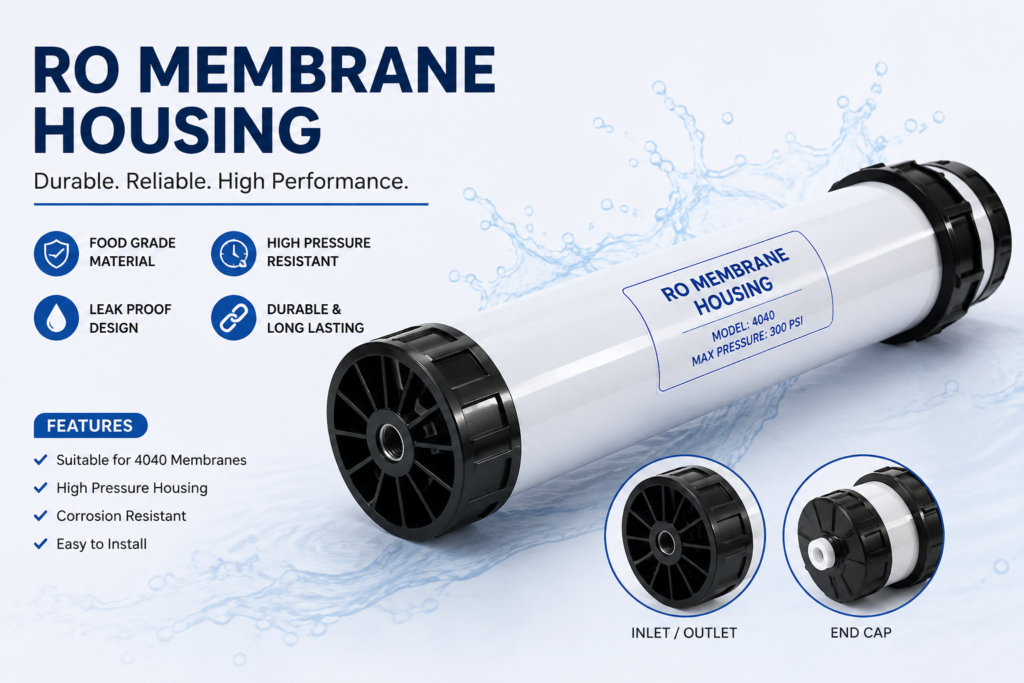
RO Membrane Housing for Water Treatment is a pressure-resistant vessel designed to contain RO membrane elements and maintain the controlled pressure and flow conditions required to separate dissolved substances from water. The correct housing depends on the membrane, system capacity, operating pressure, and water treatment application.
Understanding how membrane housing requirements change from one application to another can help system designers, plant operators, and buyers make more informed decisions.
1. The Role of Membrane Housing in Different RO Systems
Reverse osmosis uses pressure to push feed water through a semipermeable membrane.
The membrane separates the incoming water into a permeate stream and a concentrate stream.
The membrane housing provides the environment in which this process takes place.
It holds the membrane element, maintains pressure, and provides the necessary flow connections.
Although the basic function remains the same, the housing requirements can change considerably depending on the application.
For example, a residential system may require a compact vessel, while an industrial plant may require multiple pressure vessels containing several membrane elements.
The material can also vary depending on the water chemistry and operating environment.
This is why application should be considered before selecting a membrane housing.
2. RO Membrane Housing for Drinking Water
Drinking water purification is one of the most familiar applications of reverse osmosis.
RO systems can be used to reduce dissolved solids and other unwanted substances from water as part of a broader treatment process.
In smaller drinking water systems, membrane housing is typically designed around compact membrane elements and relatively lower system capacities.
The housing should provide:
- Correct membrane compatibility
- Appropriate pressure rating
- Reliable sealing
- Suitable connection configuration
- Easy membrane replacement
For larger drinking water plants, the requirements become more complex.
Multiple membrane elements may be used, and the system may operate continuously.
In these situations, pressure vessel selection needs to consider system capacity, membrane arrangement, feed water conditions, and operating pressure.
The basic principle remains the same: the housing must provide a secure and controlled environment for the RO membrane.
3. Commercial RO Membrane Housing Applications
Hotels, restaurants, offices, hospitals, educational institutions, and commercial water purification businesses may use RO systems to meet their water requirements.
A Commercial RO Membrane Housing needs to balance capacity, reliability, installation requirements, and maintenance.
Commercial systems often operate more frequently than residential systems.
This means the housing should be selected with the expected operating schedule in mind.
For example, a restaurant may use treated water for cooking and beverage preparation, while a hotel may require a larger volume of water for multiple purposes.
The membrane housing must therefore match the required membrane capacity.
Connection configuration can also become important in commercial installations because available space may be limited.
A housing that is technically suitable but difficult to integrate into the existing piping system may increase installation complexity.
4. Industrial Water Treatment Membrane Housing
Industrial applications can place significantly greater demands on RO equipment.
An Industrial Water Treatment Membrane Housing may need to accommodate multiple membrane elements and operate continuously under controlled pressure conditions.
Industrial RO systems are used in areas such as:
- Manufacturing
- Chemical processing
- Power generation
- Textile production
- Food processing
- Pharmaceutical production
- Water reuse
- Process water treatment
In these environments, system reliability can have a direct effect on production.
A housing problem may result in leakage, maintenance requirements, or equipment downtime.
For this reason, industrial pressure vessels should be selected according to detailed technical requirements.
Important factors include:
- Operating pressure
- Membrane configuration
- Number of elements
- Feed water chemistry
- Temperature
- Flow requirements
- Material
- Port configuration
- Installation environment
The housing should be treated as part of the complete RO system design rather than as an isolated component.
5. RO Membrane Housing in Food and Beverage Processing
Water quality is important throughout the food and beverage industry.
RO systems may be used to treat process water, ingredient water, or water used in other production activities.
The appropriate membrane housing depends on the specific application and the required water quality.
In food and beverage facilities, equipment may also be exposed to frequent cleaning procedures and demanding operating environments.
Therefore, material selection and compatibility with the operating environment should be carefully considered.
A suitable housing can help provide:
- Reliable membrane containment
- Stable operating pressure
- Controlled flow
- Easier membrane servicing
- Compatibility with the system design
The housing should always be selected according to the applicable equipment specifications and the requirements of the particular process.
6. Pharmaceutical and Laboratory Water Treatment
Pharmaceutical and laboratory environments can have strict water quality requirements.
RO is often used as one stage within a larger water purification process.
In these applications, the membrane housing must be compatible with the overall system design and operating requirements.
Important considerations may include:
- Material compatibility
- Pressure rating
- Sealing
- Cleanability
- Membrane compatibility
- Connection configuration
The housing should be selected according to the specific application and relevant system requirements rather than using a general-purpose vessel without technical verification.
In high-purity water systems, every component can contribute to the overall reliability of the treatment process.
7. Boiler Feedwater and Process Water Applications
Industrial facilities may use RO systems to produce water for boilers and manufacturing processes.
In boiler feedwater applications, reducing dissolved substances can be an important part of water treatment because feedwater quality influences downstream equipment and operation.
The RO membrane housing needs to support the required membrane configuration and operating pressure.
Similarly, process water applications can have very different requirements depending on the industry.
A manufacturing process may need water with controlled dissolved solids, while another application may focus on reuse or pretreatment for a downstream purification system.
The housing should therefore be selected according to the actual role of the RO system.
8. Water Reuse and Wastewater Treatment
Water reuse is becoming increasingly important for facilities seeking to reduce freshwater consumption.
RO can be used as part of treatment systems designed to recover water for suitable reuse applications.
Wastewater treatment presents additional challenges because feed water quality can be more variable than conventional freshwater sources.
Pretreatment is therefore particularly important.
The membrane housing itself must still meet the required pressure and membrane compatibility specifications.
However, the overall system design needs to account for:
- Feed water quality
- Fouling potential
- Pretreatment
- Membrane selection
- Operating pressure
- Cleaning requirements
- Recovery targets
A suitable pressure vessel is one component of a larger treatment strategy.
9. How Application Changes Housing Requirements
The same basic membrane housing concept can be used across different applications, but the specifications can change.
Capacity
Higher water demand may require more membrane elements and larger pressure vessel configurations.
Pressure
Different feed water conditions and membrane types can require different operating pressures.
Material
Water chemistry and environmental conditions can influence material selection.
Configuration
The number of membrane elements and available installation space can affect vessel configuration.
Maintenance
Systems that operate continuously may require designs that simplify inspection and membrane replacement.
Connections
Piping arrangements can vary significantly between compact and industrial systems.
Therefore, the application should be defined before choosing the housing.
10. Common Mistakes When Selecting Housing for an Application
Selecting a membrane housing based only on membrane dimensions is one common mistake.
Although membrane compatibility is essential, other factors also need to be considered.
Ignoring Operating Pressure
A housing must be rated for the intended operating conditions.
Choosing Only by Price
The lowest-priced product may not provide the required specifications or long-term value.
Overlooking Water Chemistry
Material suitability can depend on feed water characteristics.
Ignoring Port Configuration
A housing may technically fit the membrane but still create installation difficulties if the connections do not match the system.
Using the Wrong Number of Membrane Elements
The vessel configuration should correspond to the system’s membrane arrangement.
Neglecting Maintenance
Access, sealing components, and replacement requirements should be considered before installation.
Avoiding these mistakes can make equipment selection more reliable and reduce future problems.
11. How to Match RO Membrane Housing to Your System
A practical selection process begins with gathering the system specifications.
Start by identifying the membrane model and dimensions.
Then determine:
- Required system capacity
- Number of membrane elements
- Operating pressure
- Feed water characteristics
- Operating temperature
- Housing material requirements
- Connection configuration
- Installation space
- Maintenance requirements
Once these specifications are known, suitable housing options can be compared.
For commercial and industrial installations, working with an experienced manufacturer or supplier can help ensure that the selected pressure vessel is appropriate for the intended application.
12. Frequently Asked Questions
What is RO membrane housing used for in water treatment?
RO membrane housing contains the membrane element and provides the pressure-resistant environment required for reverse osmosis. It also directs feed, permeate, and concentrate water through the appropriate flow paths.
Is the same RO membrane housing suitable for every application?
No. Housing requirements can vary based on membrane size, operating pressure, water chemistry, capacity, material, and system configuration.
What type of housing is used in industrial RO systems?
Industrial systems commonly use larger pressure vessels designed to accommodate one or multiple membrane elements. The exact configuration depends on system design and membrane requirements.
Why is material important for membrane housing?
Material affects durability, corrosion resistance, pressure performance, and suitability for the operating environment. The correct material depends on water chemistry and system conditions.
Can RO membrane housing be used for wastewater treatment?
It can be used in RO-based wastewater treatment and water reuse systems when the pressure vessel is suitable for the membrane and operating conditions. Appropriate pretreatment is also important.
How does commercial RO membrane housing differ from residential housing?
Commercial housings are generally designed for higher capacities and more frequent operation. They may also accommodate larger or multiple membrane elements.
Does application affect membrane housing price?
Yes. Size, material, pressure rating, number of membrane elements, configuration, and manufacturing requirements can all affect the cost.
Conclusion
RO Membrane Housing plays an important role across residential, commercial, and industrial water treatment systems.
Although its basic function remains the same, the ideal housing can vary significantly depending on the application.
Drinking water systems may require compact configurations, while commercial systems often need greater capacity and convenient installation. Industrial applications can require larger multi-element pressure vessels designed for continuous operation.
Food and beverage facilities may have specific material and cleaning considerations, while pharmaceutical and laboratory applications can have more demanding system requirements. Water reuse and wastewater treatment systems may require additional attention to feed water characteristics and pretreatment.
The key is to avoid selecting a housing based on one specification alone.
Membrane dimensions, pressure rating, material, number of elements, connection configuration, water chemistry, capacity, and installation conditions should all be considered together.
When the housing is correctly matched to the application, it provides the membrane with the controlled environment required for reliable reverse osmosis operation.
For this reason, RO Membrane Housing for Water Treatment should be selected as an integral part of the overall system rather than as a standalone component.
The right pressure vessel can support stable operation, easier maintenance, and better compatibility across the life of the RO system.
