
Stainless Steel 304 vs. 316 Flanges: Key Differences
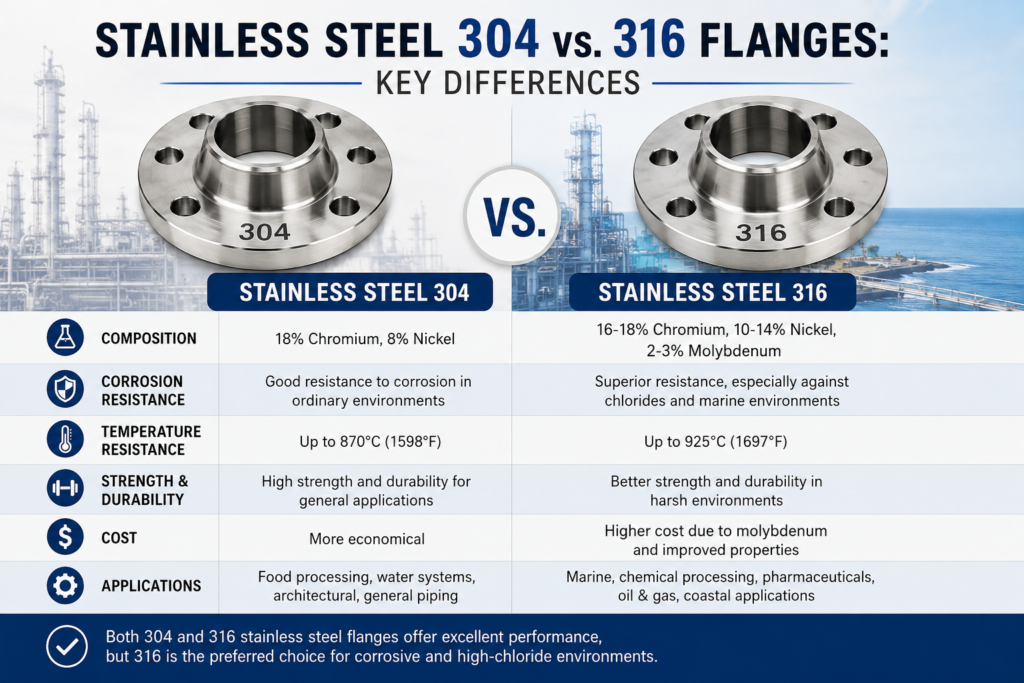
Stainless steel 304 flanges rank among the most common piping components used to connect pipes, valves, pumps, and other equipment across industrial systems. When deciding between 304 and 316 stainless steel, there are a few practical things to consider, such as corrosion resistance, operating temperature, and what the line is exposed to day in and day out. Pick that decision wrong, and the flange performs below par or costs more than the task ever needed. This blog examines the competition of 304 vs 316 in terms of composition, qualities, uses, and the purchasing decisions that really impact a project.
What Are Stainless Steel Flanges?
A flange is a piping component used to bolt two pieces of pipe, or a pipe and a piece of equipment, together to make a leak-tight union. The two flange faces are bolted together with a gasket in between and the bolts squeeze that connection tight until it seals against the pressure. That is the fundamental reason behind stainless steel flanges. A connection you can open for inspection or maintenance without tearing a line apart. For those of us who have had to shut down a section of plant only to replace a rusted weld joint, that access alone justifies the design.
Supplier interchangeability and pressure classes 150# to 2500# are manufactured to ASTM A182 and ASME B16.5 manufacturing standards. Choose the correct grade to prevent catastrophic pressure rupture under service loads. In industrial applications, stainless steel 304 and 316 grades are equally considered for the flange configuration. Weld neck flanges are for high-stress applications, distributing stress evenly. Slip-on flanges are for low-pressure operations. Blind flanges isolate lines. Choosing the correct flange for pressure, bore and maintenance helps preserve system integrity.
What Is a Stainless Steel 304 Flange?
Stainless steel 304 is an austenitic grade featuring roughly 18% chromium and 8% nickel, often referred to as “18-8 stainless.” Chromium generates a self-healing surface oxide layer that blocks rust, while nickel provides exceptional ductility, solid mechanical strength, and easy weldability. Ideal for general industrial applications, food processing, and standard piping setups, 304 flanges offer reliable performance under moderate conditions. However, they struggle against harsh chlorides and aggressive acids. Flanges made from this grade routinely hold ASTM A182 F304 and ASME SA182 certifications, verifying precise chemistry, mechanical strength, and dimensional tolerances.
304 vs 316 Stainless Steel Flanges: Key Differences
Chemical Composition
304 and 316 share the same chromium-nickel backbone, but 316 adds 2% to 3% molybdenum to the mix. That single addition changes how the alloy behaves in aggressive environments more than any other factor in the comparison.
Corrosion Resistance
304 performs reliably in standard industrial atmospheres, water systems, and most food-grade applications. Molybdenum in 316 gives it noticeably better resistance to pitting and crevice corrosion, particularly where chlorides are present. That’s why stainless steel 316 flanges show up so often in marine environments, coastal facilities, and chemical processing plants where saltwater spray or aggressive process chemicals would eat through 304 over time.
Mechanical Properties
Tensile strength, durability, and toughness stay close between the two grades. Neither one gives up meaningful mechanical performance to the other, and both hold their shape and load capacity well through normal thermal cycling. An engineer specifying a flange purely for structural load, without corrosive exposure in the picture, can generally treat 304 and 316 as mechanically comparable options. The real decision almost always comes down to what the flange has to survive chemically, not what it has to carry mechanically.
Temperature Resistance
Both grades handle a broad temperature range well, resisting oxidation and scaling at elevated service temperatures. 316 tends to edge ahead in sustained high-temperature, high-corrosion combinations, since the molybdenum content helps maintain that protective oxide layer even as heat accelerates most corrosion mechanisms. 304 remains perfectly serviceable across standard operating ranges most industrial systems run at, and switching to 316 purely for temperature performance, without a corrosion driver behind it, rarely pays for itself.
Cost Comparison
Molybdenum costs money, and that shows up directly in the price difference. 316 flanges generally run more expensive than 304, sometimes significantly so depending on market alloy pricing at the time of purchase. The instinct to save money by defaulting to 304 across an entire project makes sense on paper until one section of the system calls for 316’s corrosion resistance. At that point, the cheaper flange becomes the more expensive decision, once premature failure, unplanned downtime, and replacement labor enter the picture. Specifying grade by application rather than by a single project-wide default tends to control cost better over the long run.
Applications of Stainless Steel 304 Flanges
- 304 flanges are used in water treatment plants to keep the fluid pure and free from rust contamination.
- 304 flanges are applied in food processing equipment to satisfy stringent sanitary standards in daily production.
- 304 flanges are used in pharmaceutical manufacturing lines to keep the sensitive chemical processes sterile
- 304 flanges are used in general industrial pipe systems to provide reliable leak free connections at typical operating pressures
- HVAC systems use 304 flanges to reliably handle circulating water and coolant lines for long periods of time.
- 304 Flanges are applied in structural fabrication projects to give stable load bearing support to industrial pipe assemblies
- Commercial process equipment uses 304 flanges to offer long-lasting durability at a pricing point.
Applications of Stainless Steel 316 Flanges
- 316 flanges are used in marine engineering applications because they can tolerate significant pitting due to exposure to saltwater
- 316 flanges are used on offshore platforms because they are resistant to harsh sea conditions and high humidity in the air.
- 316 flanges are used in chemical processing businesses to safely process volatile organic compounds and highly corrosive acids
- 316 Flanges are used in petrochemical industries to keep the structure intact at high temperatures and strong chemical flows.
- 316 flanges are utilized in desalination plants where they are exposed to high concentrations of brine solutions without the material degrading quickly.
- 316 flanges are fitted in power generation plants to provide tight seals in high pressure steam and cooling systems.
- 316 flanges are also utilized in coastal infrastructure installations to protect against the atmospheric corrosion caused by high sea spray and salt air.
Benefits of Stainless Steel Flanges
The mechanical strength of stainless steel flanges is excellent, and they are capable of withstanding high pressure spikes without dissolving.
- The component is naturally corrosion-resistant and has a long lifespan without being prematurely replaced.
- Weldability and machinability are improved, which means that labour costs are reduced in installation and manufacturing schedules are maintained.
- Leak-proof sealing enables long-term process separation, preventing expensive fluid losses and downtime.
- These heavy-duty flanges offer the best lifetime economics available today with a low total cost of ownership.
How to Choose the Right Stainless Steel Flange
Selection starts with the operating environment. Chloride exposure, corrosive chemicals, temperature swings, and pressure requirements all shape which grade and pressure class actually fit the job. A plant sitting a few miles from the coast deals with airborne salt even on lines that never touch seawater directly, which is exactly the kind of exposure that tips a decision toward 316 even in a “standard” industrial setting. From there, the flange type needs to match the piping system it connects to, whether that’s a weld neck flange for a high-pressure line or a slip-on flange for something less demanding.
Documentation is as important as metal. ASTM standards, material certificates, and testing reports verify that the flange in hand is what the mill certificate says it is. Skipping this step allows counterfeit or misgraded material to enter a crucial line. Check bolt patterns, gasket seating surfaces, and connected equipment before ordering, not after delivery. Source from an experienced stainless steel flange manufacturer to decrease the risk of a fit problem mid-installation, which costs far more than a design delay.
A few project errors recur. Buyers choose the wrong material grade for service or ignore corrosion exposure and assume any stainless steel would work. Line pressure ratings are off. Instead of testing, pipeline compatibility is assumed. Certifications and inspection reports aren’t verified until an audit, usually at the worst time. Initial cost often outweighs long-term performance, which usually costs more in downtime and premature replacement than the grade upgrade would have.
Conclusion
The difference between 304 and 316 stainless steel flanges comes down to one alloying element and what that element does under real operating conditions. Molybdenum in 316 buys meaningfully better corrosion resistance for marine, coastal, and chemical processing environments, at a real cost premium that 304 doesn’t carry. Understanding that trade-off, alongside the composition, application range, and cost differences covered here, gives engineers and buyers what they need to specify the right grade rather than guess at it. Working with an experienced stainless steel flange manufacturer such as Neo Impex Stainless Pvt. Ltd. can further help ensure the selected flanges meet the required specifications, quality standards, and long-term performance expectations for the application.
